
Last Updated: November 4, 2026
Quick Summary
A 15 minute morning workout for busy people is a short routine of about seven bodyweight moves, such as squats, push-ups, lunges and planks, done at home with no equipment. Perform each exercise for 40 seconds, rest for 20 seconds, and repeat the circuit once if time allows.
Busy mornings rarely leave room for a long workout, but a focused 15 minute morning workout for busy people can build strength, energy and consistency at home. This guide is written for beginners and busy adults who need a practical plan they can actually follow. Below, you will find a no-equipment routine, a weighted version, modifications for beginners, and ways to keep the habit going when life gets hectic.
A short session is easier to start, and starting is most of the battle. When a workout takes 15 minutes, the excuse of “I don’t have time” loses much of its weight. Many people find that a brief routine done first thing feels more manageable than a long session squeezed in after a full day.
The morning also has practical advantages. Fewer interruptions are likely before work, and the session gives you a clear win before the day gets busy. Movement can also help you feel more awake and focused, which is why many people use a quick routine as a daily reset.
The real goal is consistency, not perfection. A realistic plan you repeat most mornings usually beats an ambitious one you abandon after a week.
You can complete this routine without any gear. Perform each exercise for 40 seconds, rest for 20 seconds, and move to the next one. Repeat the circuit once if you have time.
Keep your pace steady rather than rushed. Good form matters more than speed.
Muscles that have not moved since waking up are more prone to strain, so start with two minutes of gentle movement. Try arm circles, hip circles, and slow bodyweight squats. Finish with a short cool-down of stretching for the calves, hamstrings and chest, holding each stretch for about 20 seconds. This preparation takes little time and helps the workout feel smoother.
The no-equipment circuit uses timed work and rest intervals, summarised below.
| Step | What to do | Time |
|---|---|---|
| Warm-up | Gentle movement such as arm circles, hip circles and slow squats | Two minutes |
| Circuit exercises | Seven moves, each performed for work and rest intervals | 40 seconds work, 20 seconds rest |
| Repeat | Repeat the circuit once if time allows | Once |
| Cool-down | Stretch calves, hamstrings and chest | About 20 seconds per stretch |
If you have a set of adjustable dumbbells or light weights, you can add resistance to the same movement pattern. Choose a weight you can lift with control for 10 to 12 repetitions. A set of adjustable dumbbells lets you adjust resistance as you get stronger.
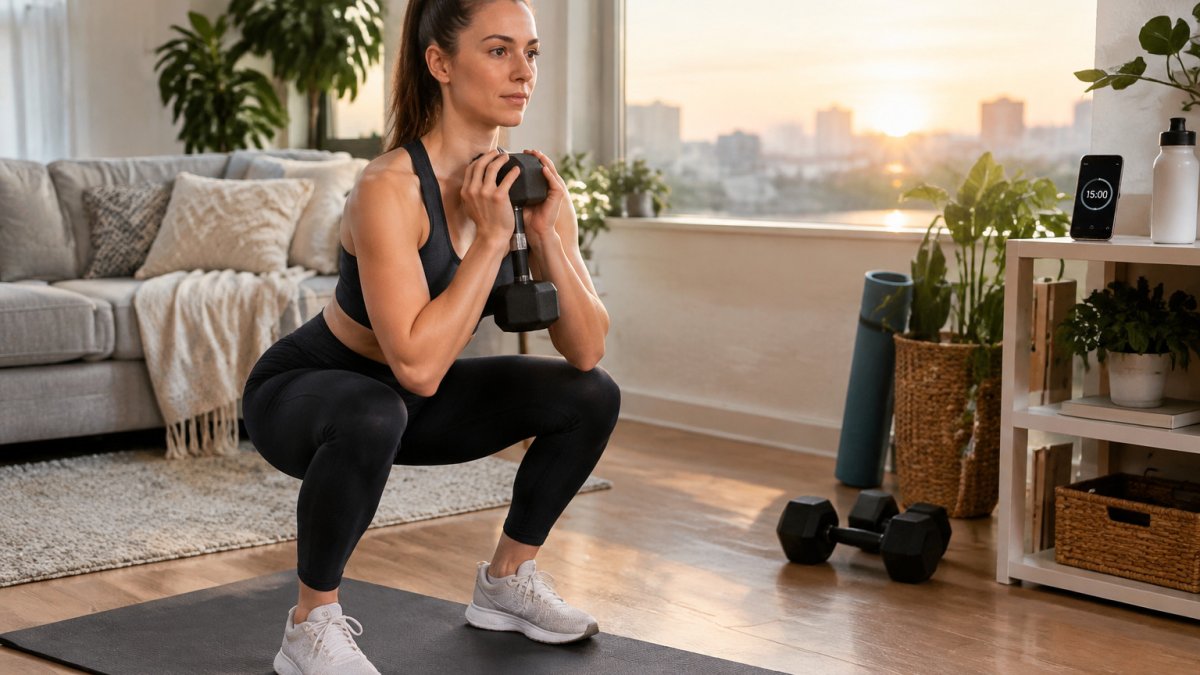
Use the same format: 40 seconds of work, 20 seconds of rest.
Ankle weights can add extra load to leg exercises for people who are ready for more challenge, though they are best used with lighter movements such as marching or glute bridges. Browse adjustable ankle weights in several weight options to choose a load that suits your level.
New exercisers often do best when they start with fewer reps and longer rest. Reduce each exercise to 20 seconds of work and 40 seconds of rest. Use the incline version of push-ups, perform squats to a chair, and skip jumping movements.
As the routine becomes easier, progress in small steps: add a few seconds of work time, shorten the rest, or hold a position for longer. A balance ball can add stability and challenge to floor and core moves once you feel comfortable. Many beginners find that small, steady changes keep them motivated without causing soreness that stops them from training.
High-intensity interval training, or HIIT, alternates short bursts of hard effort with recovery. Steady-state exercise keeps a moderate pace for the whole session. Both can fit in 15 minutes, and the right choice depends on your current fitness and how you feel.
HIIT can be efficient, but it is demanding. If you are new to exercise or still waking up, a moderate pace is often the better starting point. Choose higher intensity when you feel rested and have done some training before. Keep the effort controlled so you can finish the session and return the next morning.
Most people who quit a morning routine do not quit because the workout was too hard. They quit because the decision to start kept getting re-litigated every morning. The fix is to make the start automatic and to plan for the specific barriers that show up in a busy household or a packed work calendar.
For the first 15 to 30 minutes after waking, many people experience sleep inertia, a groggy, slow-feeling state while the brain transitions out of sleep (Module 7. Napping, an Important Fatigue Countermeasure, Nap Duration | NIOSH). It is normal, it fades, and it is the single biggest reason a 6 a.m. workout gets skipped. Two practical responses work better than willpower:
Habit research popularized by writers like James Clear describes a simple loop: cue, routine, reward. The cue is the part most people skip. Instead of relying on feeling motivated, attach the workout to something you already do every morning without thinking:
The routine is the 15-minute session. The reward is the part you choose deliberately, a favorite podcast during the workout, a few minutes of quiet with your coffee afterward, or simply marking an X on a paper calendar. A visible streak is a surprisingly strong motivator for busy people because it makes the cost of skipping feel concrete.
Generic advice like “just wake up earlier” ignores the real constraints. A more useful approach is to name the barrier and pre-plan the response:
The most common failure pattern is not missing one morning, it is the all-or-nothing reaction to missing one morning. A missed day is data, not a verdict. The rule that works for most busy people is simple: never miss twice. Return the next morning with the easiest version of the routine, and the streak resumes.
Track consistency rather than intensity for the first month. Four short sessions a week beats two perfect ones followed by a crash, and the habit is what carries the routine through the weeks when life gets loud.
Pick the routine that fits your current level, set a timer for 15 minutes, and begin tomorrow morning. Our curated selection of fitness equipment, supplements and recovery tools is backed by vendor warranties and a 30-day return policy, with direct-to-doorstep shipping. Browse our collection to explore products that can support your routine and make your mornings a little easier to stick with.
Fifteen minutes a day can produce real gains in strength, mobility and energy when the sessions are consistent and the effort is genuine. Results depend on intensity, how often you train and your nutrition and sleep. Visible muscle changes generally take longer than improvements in energy and movement. Pushing the pace, shortening rest periods and progressing reps or load each week helps the short session deliver more.
No. A full routine can be built from bodyweight moves such as squats, push-ups, reverse lunges, glute bridges, planks and marching in place. If you want more challenge, a pair of adjustable dumbbells or resistance bands adds load to the same movements. Start with no equipment for the first two weeks, then add weights once the movement patterns feel comfortable and controlled.
Lay out your clothes the night before, pick one fixed time, and keep the workout on your calendar like any other appointment. Use a simple checklist to track completed days. If your schedule slips, do a shortened 7-minute version rather than skipping entirely. Consistency matters more than any single session, so protecting the habit is the goal.
You can build some muscle in 15 minutes a day, especially as a beginner, because bodyweight and dumbbell exercises still create meaningful resistance. Progress is slower than in longer programs, so focus on full body compound movements, controlled reps and gradually increasing difficulty. Adequate protein intake and recovery between sessions support muscle growth.

