
Last Updated: October 12, 2026
Is premium recovery gear worth the investment? The U.S. Forest Service off-highway vehicle safety guidance makes the same point about trail preparedness, noting that proper equipment and planning prevent most backcountry emergencies.
Here is the tension nobody resolves for you: budget recovery gear is not automatically dangerous, and premium recovery gear is not automatically right for your rig.
The differences that matter are rated capacity, material quality, and how the gear behaves under a real recovery load.
Premium buys three things: verified load ratings, better materials, and predictable behavior under load. Everything else, including branding and packaging, is noise.
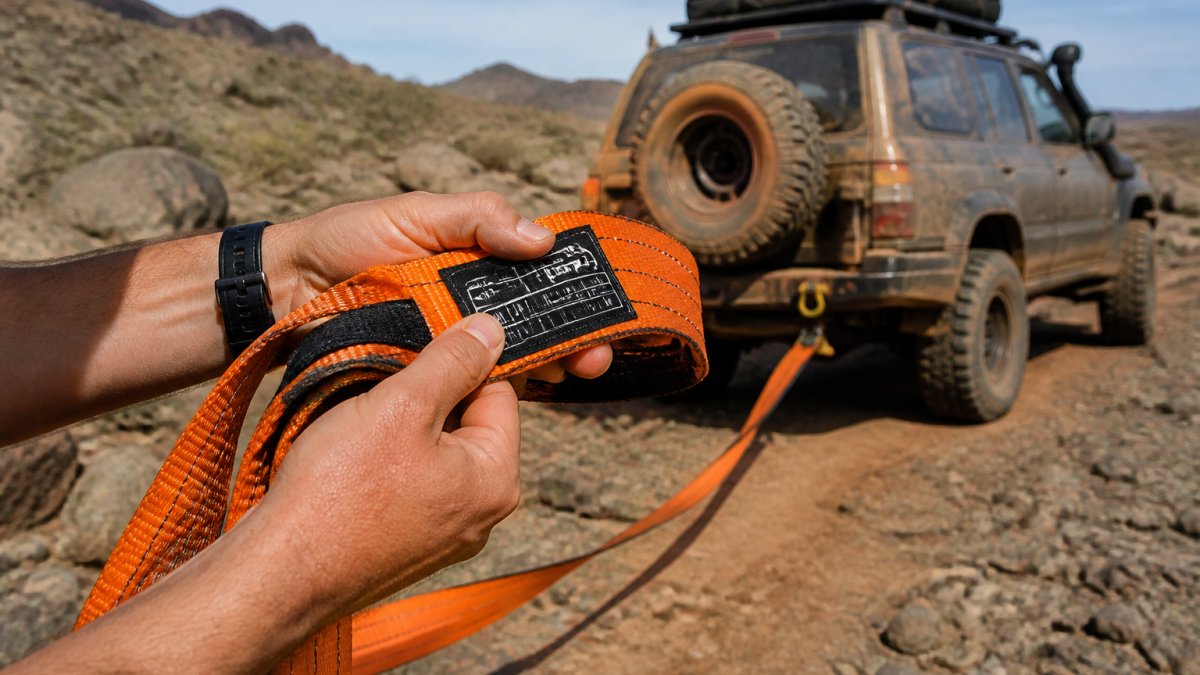
A recovery strap is a flat, woven strap designed to stretch slightly and transfer pulling force between two vehicles. A kinetic recovery rope is a nylon rope engineered to stretch and store energy, then release it to pull a stuck vehicle free.
Recovery straps handle steady, controlled pulls: towing a disabled vehicle, steadying a rig on a slope, or a gentle tug on firm ground. They are not built for high-speed snatch recoveries, and using one that way is how straps and windshields break.
Budget straps often carry vague or missing load ratings. Premium straps state a working load limit and a breaking strength, and those two numbers tell you how the strap is meant to be used.
Soft shackles are flexible synthetic connectors that replace steel D-rings at the recovery point. They weigh less, do not rust, and store in a glovebox. Metal D-rings are cheaper and tolerate abrasion better, but a snapped steel shackle becomes a projectile.
Premium soft shackles come with a stated breaking strength and a safety factor. Budget versions often skip both. That missing number is the entire product.
A kinetic recovery rope stretches to build momentum; a tow strap does not.
Kinetic ropes are rated by breaking strength and by the vehicle weight range they are built to recover. A rope rated far above your rig’s weight will not stretch enough to work well.
Tow straps are for flat towing and gentle pulls at low speed. They are cheaper, simpler, and completely adequate for that job.
A winch is worth the money when you travel alone, in mud, or on trails where no second vehicle will pass.
High-lift jacks are a different calculation. They are excellent for lifting a lifted rig off an obstacle and for winching sideways in a pinch.
Where premium pays off most is anything that holds load under tension: winch line, shackles, and recovery points.
Match gear to your vehicle’s loaded weight, not its curb weight, and always buy above your recovery load.
The rule we use: take your loaded vehicle weight and add the weight of the stuck vehicle if you are pulling someone else.
Most buying guides skip this, and it is the single most useful thing to understand before you spend money. Three numbers matter, and they are not interchangeable:
A few practical rules follow from that:
The table below compares typical specifications and use cases so you can see where premium pricing actually lands. Ranges reflect what is commonly available; verify the specific rating on the product you buy.
| Gear Type | Typical Material | Typical Breaking Strength Range | Typical Price Range | Best Use Case | Premium Worth It? |
|---|---|---|---|---|---|
| Tow strap | Woven nylon or polyester, low stretch | 20,000-30,000 lb | $25-$60 | Flat towing, gentle low-speed pulls | Rarely, buy a rated budget strap |
| Kinetic recovery rope | Nylon, engineered stretch | 25,000-40,000+ lb | $100-$300 | Snatch recoveries, stuck vehicles | Usually, stretch and energy storage matter |
| Soft shackle | UHMWPE (Dyneema) | 20,000-50,000 lb | $30-$90 each | Replacing steel D-rings at recovery points | Usually, weight and safety under failure |
| Steel D-ring / shackle | Forged steel | 10,000-30,000 lb WLL | $15-$50 each | Anchor points, abrasion-heavy pulls | Sometimes, buy rated, not cheapest |
| Traction boards | Reinforced polymer | Not load-rated the same way | $100-$350 per pair | Sand, snow, mud self-recovery | Often, cheap boards crack under load |
| Winch | Electric, steel or synthetic line | 8,000-12,000 lb capacity | $400-$2,000+ | Solo travel, heavy terrain | Yes if you travel alone |
Two things stand out in that table. First, the price gap between budget and premium is largest on kinetic ropes and soft shackles, which are also the items most likely to be loaded under tension.
| Vehicle Type | Loaded Weight Range | Rope or Strap Rating to Look For | Winch Worth It? |
|---|---|---|---|
| Compact SUV | Light | Entry-level kinetic rope | Rarely |
| Mid-size truck | Moderate | Mid-range kinetic rope, rated shackles | Sometimes |
| Full-size truck | Heavy | Heavy-duty kinetic kit, high-rated shackles | Usually |
| Modified rig | Very heavy | Heavy-duty kinetic setup with verified ratings | Yes |
The ARB Premium Recovery Kit is positioned for exactly that last row: a heavy-duty, kinetic-based setup aimed at larger vehicles. The Bubba Rope Gator-Jaw shows up in off-road communities as a go-to among experienced drivers. Neither is necessary for a stock SUV on easy trails.
Buy in this order, and skip anything you cannot verify a rating for:
The MAXTRAX XTREME is a well-known traction board option for sand and mud, and boards solve a lot of stucks with no rope at all. One caution: a separate review warns that some recovery boards priced under $150 per pair can fail, though it does not establish whether that applies to this model. That warning is the whole argument for buying boards with a stated rating.
Inspect recovery gear before every trip and retire anything with damage, no exceptions. This is the angle most buying guides skip, and it is where premium gear earns its keep over time.
Premium gear typically survives more inspection cycles because the materials start better. That is a real cost saving, just a slow one.
| Gear | Inspect | Retire When |
|---|---|---|
| Kinetic rope | Every trip | Cut, glazed, or stiff |
| Soft shackle | Every trip | Frayed or UV-cracked |
| Winch line | Monthly | Flat spots or broken fibers |
| Steel shackle | Every trip | Cracked or deformed |
Buy premium recovery gear if you wheel alone, drive a heavy rig, or travel terrain where a failed recovery is a real safety problem.
The middle path is the one we recommend most often: premium rope, shackles, and recovery points, budget everything else. Those three items hold load under tension, and they are the ones where a failure has consequences.
If you are building out a recovery kit alongside your fitness and wellness routine, Today’s Wellness Zone carries 100% original fitness equipment and recovery tools, each covered by a vendor warranty and backed by a 30-day return policy, shipped directly to your door.
For drivers who hit trails regularly or own a heavy rig, premium recovery gear is worth the investment because it delivers higher working load limits, better material quality, and predictable performance under recovery force. Casual users who rarely leave pavement may find budget options sufficient. The deciding factors are how often you wheel, your vehicle weight, and whether a gear failure could put people at risk.
A kinetic recovery rope stretches to store and release energy, which helps free a stuck vehicle with a smoother pull. A tow strap is designed for flat towing or gentle pulls and does not stretch. Using a tow strap for a snatch recovery can shock-load the strap and recovery points, causing dangerous failures. Match the tool to the job: kinetic rope for stuck vehicle recovery, tow strap for towing on solid ground.
Spending should track your vehicle weight and how often you go off-road. A starter kit with a recovery strap, soft shackles, and gloves covers light trail use. Heavy rigs and frequent trail recovery justify premium equipment with rated breaking strength and a clear safety factor. Start with the gear your vehicle and terrain demand, then upgrade as your experience grows.
A common mistake is using unrated or mismatched gear, such as a tow strap for a snatch recovery or a D-ring with no working load limit stamped on it. Another is ignoring gear inspection: frayed synthetic rope, bent shackles, or worn straps can fail under load. Always check ratings, inspect before every trip, and never exceed the recovery point’s capacity.
Beginners should start with a recovery strap or kinetic rope rated for their vehicle weight, two soft shackles, a pair of gloves, and a tire deflator. Add traction boards if you drive sand, mud, or snow. A winch and high-lift jack can wait until you know your terrain and have training. This off-road recovery gear checklist keeps the initial investment practical.
Getting stuck is not the problem. Getting stuck with gear that cannot take the load is. Start shopping with Today’s Wellness Zone and build a recovery kit you can trust, with original products, vendor-backed warranties, secure checkout, and a 30-day return policy if something is not right for your rig.
