
Last Updated: November 3, 2026
Quick Summary
Desk stretches can help. Short movements done in your seat ease physical tension from sitting and give your mind a brief break from the screen, which many people find helps them return with a clearer head. Pick one or two moves that target your biggest complaint, such as wrist stretches for typing or chin tucks for long video calls.
Sitting for hours is one of the most common habits behind that foggy, sluggish feeling at work. This guide explains how simple desk stretches to improve focus can help. You will also learn which moves are worth trying first.
Your body and brain are connected. Staying in one position for a long time can leave muscles feeling stiff, and many people notice their attention drifting by mid-afternoon.
Here’s the thing most people miss: the problem isn’t only the chair. It’s the lack of movement that breaks up the day.
Think of stretching as a quick reset rather than a workout.
Desk stretches are short movements you can do without leaving your seat. They can help ease physical tension and give your mind a brief pause from the screen.
The benefits people commonly report tend to show up in a few ways:
Start with moves that target the areas most likely to feel tight after a long day at a computer. You don’t need any equipment, and each stretch takes less than a minute. What separates a useful stretch from a random one is matching the move to the demand your work puts on your body, so the list below is organized by the two most common desk roles.
If your hands are on a keyboard most of the day, the wrists, forearms, and upper back take the brunt of it. These three moves target that pattern.
If your day is mostly meetings, your neck and upper back carry the load, and you may not get up between calls at all. These moves can be done without leaving your chair and without turning your camera off.
Long sitting shortens the hip flexors and hamstrings, which is why your lower back often aches before your legs do. Two moves cover most of it.
For a desk break, one round of each move is enough, the goal is to interrupt stiffness, not to train for flexibility. If you only have time for one move, pick the one that matches your biggest complaint that day.
Watch out: bouncing or forcing a stretch past a mild pull is the most common way people turn a helpful break into a sore neck or wrist. Stop at the point of gentle tension, not pain.
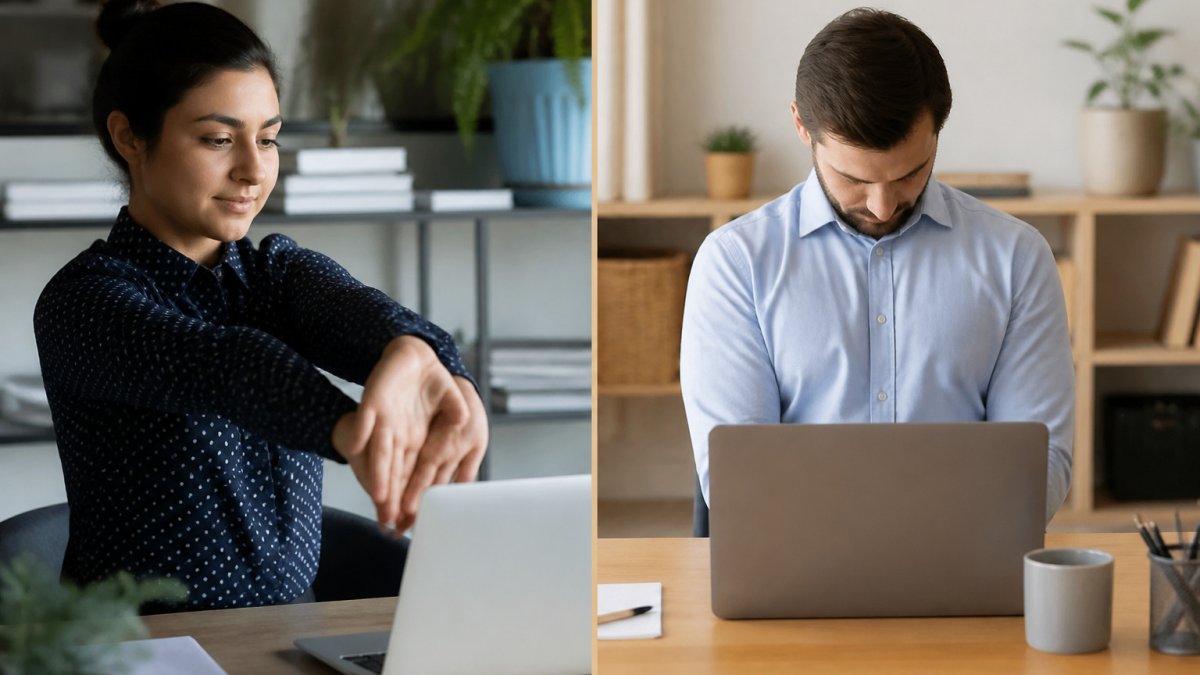
The article groups its desk stretches by the kind of desk work that strains the body most, so the table below matches each move to its best use. For guidance on picking a mouse that suits your hand size, see a fit guide for choosing a mouse for small hands.
| Stretch | Best for | Hold or reps |
|---|---|---|
| Wrist flexor stretch | Heavy typists and mouse users | 15-20 seconds per side |
| Wrist extensor stretch | Heavy typists and mouse users | 15-20 seconds per side |
| Doorway chest opener | Heavy typists and mouse users | 20-30 seconds |
| Chin tuck | Back-to-back video calls | 5 seconds, 10 reps |
| Seated shoulder-blade squeeze | Back-to-back video calls | 5 seconds, 10 reps |
| Seated neck tilt | Back-to-back video calls | 15-20 seconds per side |
| Seated hamstring stretch | Seated leg and hip tightness | 20-30 seconds per side |
| Seated figure-four | Seated leg and hip tightness | 20-30 seconds per side |
If you want a structured plan, try this five-minute routine once or twice a day:
Keep it simple. Consistency matters more than doing every move perfectly. If you want to build strength in the wrists and forearms alongside these moves, an adjustable hand gripper for grip strength and forearm endurance is one option.
Both approaches have a place in a workday. Standing desk stretches can add more movement, such as calf raises, gentle hip circles, or a standing side bend. They work well if you already use a standing desk.
Seated moves are easier to do in a regular office chair and in meetings. Many people use a mix of both. If you’re new to stretching, start seated and add standing moves once the habit feels natural.
Timing can matter as much as the moves themselves, because your body’s daily rhythm, the circadian rhythm, can change what kind of movement feels helpful at different points in the workday.
Core body temperature, alertness, and muscle stiffness all follow a daily pattern. That means the same stretch can serve a different purpose depending on when you do it.
First thing in the morning, tissues are stiffer and the goal is gentle circulation rather than deep stretching. A short sequence of shoulder rolls, a seated spinal twist, and slow neck tilts is enough to shake off overnight stiffness. Keep holds short, around 10 to 15 seconds, and avoid aggressive stretching before your body has warmed up.
A simple breathing pattern for the morning is a longer exhale: inhale for four counts and exhale for six. Many people find a longer exhale feels calming when easing into a demanding day.
The early-afternoon slump is the most predictable low point for most desk workers. Scheduling a stretch break just before that dip, rather than after you already feel foggy, is the practical move. A five-minute routine of standing calf raises, hip circles, and a doorway chest opener gets blood moving to the large muscles and gives your attention a reset before the slump sets in.
For breathing during this window, box breathing works well: inhale for four counts, hold for four, exhale for four, and hold for four. Repeat three to five times.
By late afternoon, tension has usually built up in the neck, shoulders, and lower back. This is the best window for the longer holds, 20 to 30 seconds, on the neck tilt, shoulder-blade squeeze, and seated hamstring stretch. Pair them with a slow breathing pause to close out the workday.
Watch out: holding your breath during hard tasks is a common habit, and it quietly amplifies tension. If you notice yourself tensing up, a single slow exhale is often enough to reset before the stiffness compounds.
If you remember nothing else, use this: gentle movement and longer exhales in the morning, a pre-slump stretch break in the early afternoon, and longer static holds in the late afternoon.
circadian rhythm and alertness overview
Pick one or two moves from this guide and try them today. Set a reminder for a stretch break every hour or two. Over time, you’ll learn which moves feel best for your body.
To keep the routine handy, save this guide or print the five-minute routine and tape it near your monitor. Many readers find a visible reminder makes the habit stick.
For help planning your workday, our guide on prioritizing tasks to avoid workplace burnout covers practical steps. And if you want a routine to follow after work, see our habits for recovering from a long workday. Start small, stay consistent, and check in with your body as you go.
Yes, short stretch breaks can help. Brief movement can interrupt the stiffness that builds during long periods of sitting, which some office workers notice as mental fog or restlessness. Stretching does not replace sleep, hydration or a proper workload, but a short reset every hour or so may make it easier to return to a task. Start with a few simple moves and notice how you feel over a typical workweek.
The most useful desk stretches target the areas that tighten during screen work: neck rolls, shoulder shrugs, chest openers, seated spinal twists, wrist extensions and hamstring stretches while seated. Hold each stretch for about 20 to 30 seconds and breathe slowly. Focus on comfortable range of motion rather than pushing into pain, and stop any move that causes sharp discomfort.
A common approach is a one-minute movement break every 30 to 60 minutes, with a longer five-minute routine once or twice a day. Set a reminder if you tend to lose track of time. Consistency matters more than perfection, so choose a schedule you can realistically keep on busy days.
Standing desk stretches add balance and full-body movement, such as heel raises, gentle lunges and side bends, while seated stretches focus on the neck, shoulders, wrists and legs without needing space. If you use a standing desk, alternate between standing and seated moves to vary your posture. Both styles can help reduce stiffness during long workdays.

